By Louisa Chinyavu and Priscilla Kagwa
Along Kenya’s coastline, conservation rests with communities who navigate life by the ocean charting tides, customs and bylaws.
Within the Lamu Archipelago, from Matondoni to Pate Island, communities tethered to the coastal ecosystem are increasingly finding ways to sustain themselves while protecting the very environment that has supported them for generations. For many, these islands are the only home they have ever known.
But with growing environmental and economic pressures straining coastal livelihoods, communities are also being pushed to find more resilient ways of navigating everyday life steered by tradition.
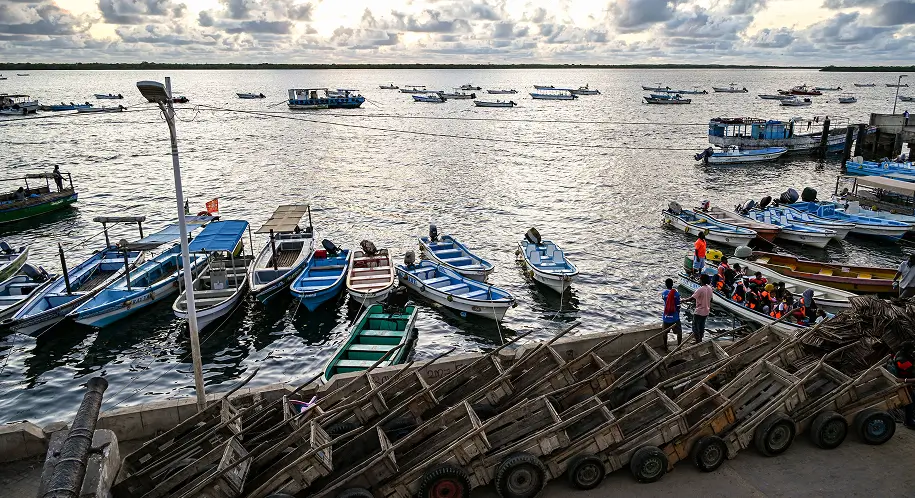
A visit to the Lamu Archipelago quickly reveals a deep connection between people, culture, and the environment around them. The islands carry a strong sense of heritage and community. Boats moving between islands remain a common sight across the archipelago, connecting communities surrounded by a network of tidal channels including extensive mangroves stretching along the shoreline, seagrass meadows and fringing reefs, contributing to its rich marine biodiversity. At low tide, roots emerge from the mud as birds perch quietly above them while crabs disappear into holes almost as quickly as they appear. Life here moves with the rhythm of the ocean.
But beyond the scenery, one thing becomes increasingly clear: the strong connection communities continue to hold with the ocean surrounding them. Whether through fishing, tourism, or everyday life along the coast, communities remain deeply aware that their future is tied to the health of the environment around them. Across the islands, there is also a growing desire to find ways of protecting this critical ecosystem while still creating sustainable opportunities that support livelihoods and long-term resilience.
In Matondoni, celebrations do not arrive quietly. The sun ascends over this village, casting a golden glow across it, yet the heat does nothing to dampen the rhythmic pulse of life already in motion. Within the compound of the Matondoni Tarazak Women Group, the atmosphere is electric, transformed into a living mosaic of vibrant fabrics and resonant sound. This is the day of the Village Savings and Loan Association (VSLA) profit distribution, a milestone reached through months of disciplined collective effort and financial stewardship. Children weave through the area, darting past festive streamers and intricate, hand-woven decorations as their laughter dances over the steady, heartbeat-like rhythm of the drums. In the center of this celebration, the women sit in a composed, proud circle, witnessing the tangible results of their shared labor. Their presence is a testament to the empowerment found in communal financial models, where small, consistent contributions bloom into significant economic security for the entire household.
Steady rhythmic footsteps through the narrow, winding streets leading into the gathering, as the Governor of Lamu, Issa Timamy, arrives alongside a procession of dignitaries and invited guests, signal that this moment carries weight far beyond a simple exchange of currency. The ceremony becomes a public reflection of endurance, resilience, and collective effort.
Only two years ago, the idea of tilling the earth in this coastal village, a landscape long dominated by the salt-crusted traditions of the fishing trade and the dense, labyrinthine roots of the mangrove forests seemed impossible to the locals. Agriculture was a foreign idea, a concept that felt entirely out of place against the backdrop of the Indian Ocean. Yet, as the women stand proudly before their crops, they transform that skepticism into a living, breathing reality. They have taken barren expectations and through sheer collective will, cultivated a harvest that promises a new era of prosperity. Supported by Wetlands International Eastern Africa through the Mangrove Capital Africa project, the group has established a farm aimed at strengthening livelihoods within the community while easing pressure on mangrove resources that many households have long relied on for income and daily needs. What began as a small initiative has gradually become one of the main drivers behind the growth of the group’s savings culture and financial resilience.
Today, the women are harvesting produce that is sold within the community and supplied to nearby schools. Income generated from the farm has strengthened their savings group, allowing members to save consistently and support one another financially. The progress has been significant enough that the group has already used part of the farm’s profits to acquire additional land, with plans to expand their permaculture activities even further.
For many of the women gathered during the ceremony, the transformation goes beyond income alone.
“We continue because we are harvesting, selling, and saving from what we produce. The biggest thing that helped strengthen our VSLA was the farm that Wetlands International helped us establish,” says Swabra Mohamed, one of the leaders of the Matondoni Tarazak Women Group.
But Matondoni is only one example of how communities across the archipelago are exploring new ways of connecting livelihoods with environmental stewardship interwoven with culture.
Further north in Pate Island, the rhythm of livelihoods takes on a different form. Here, life moves with tides. Routes between islands shift depending on the movement of the ocean, and journeys into Pate often carry visitors through narrow channels edged by mangroves before opening into an island layered with Swahili history, fishing culture, and centuries of coastal life.
On the island, members of the Pate Resources and Tourism Initiative (PRATI) continue searching for ways to build opportunities around the culture and environment that have long defined life in Pate.
Plastic waste continues to choke the coast, with bottles and waste materials often ending up on beaches, within settlements, and in fragile marine ecosystems. In response, the group collects discarded plastic bottles and repurposes them into a small community recreational space, demonstrating how waste materials could be creatively reused while encouraging cleaner surroundings within the community.
In Pate, conversations around conservation have also increasingly intersected with culture, heritage. Rooted in Swahili culture and framed by living shorelines, the island has over the years seen community-led efforts exploring economic activities connected to local culture and the natural environment. Near the shoreline, discarded plastic bottles that once washed up along beaches and settlements now rise into something entirely different.
Built by members of the Pate Resources and Tourism Initiative (PRATI), a small seaside restaurant constructed using recycled plastic bottles stands as both a community space and a reflection of how the island continues reimagining waste and livelihoods. Thousands of collected plastic bottles are carefully fitted within wooden structures, allowing light and ocean breeze to pass through the colourful walls while overlooking the surrounding coastline. The bottles come from beaches, settlements, and shorelines around the island, gathered through community clean-up efforts responding to the growing challenge of plastic waste entering fragile marine ecosystems.
Though modest in scale, the space becomes part of a wider vision within the island, where communities continue shaping tourism experiences rooted in heritage, ocean life, and everyday coastal realities.
Women within the group also explore opportunities connected to local cuisine and hospitality, while discussions around crab farming and fisheries-linked enterprises slowly become part of broader conversations around livelihoods and the future of the island.
Beyond Pate, the wider archipelago continues reflecting how deeply livelihoods, culture, and the ocean remain intertwined. On Lamu island, dhow culture is the engine of both conservation and tourism. This living heritage of handcrafted boats fused with Swahili-maritime skill is passed down for centuries becoming the island’s tourism attraction. At the same time, the community uses traditional dhows to access mangrove sites enforcing bylaws that protect this critical ecosystem. Sails have opened conversations around local hospitality, cultural exchange, fisheries, restoration and how communities within the archipelago are carving out their own place within the growing blue economy.
Like many community-led efforts across the coastline, the journey has not unfolded in a straight line. Some ideas have grown, others stagnated, while some continue to evolve alongside the realities facing communities along the coastline. Yet beneath it all remains a shared determination to create opportunities that allow the community to sustain themselves while remaining connected to the ocean, culture, and heritage that define life across the archipelago. And in many ways, that determination mirrors the tides surrounding Pate itself, constantly shifting, but always moving forward.
Although different in scale and approach, the stories unfolding across these islands carry a common thread. Across the wider Western Indian Ocean region communities are increasingly demonstrating that conservation is not separate from livelihoods, culture, or everyday life. Instead, the ocean remains closely tied to identity, resilience, and survival itself. Community-led approaches are increasingly gaining attention through initiatives supporting coastal resilience and sustainable livelihoods. Programmes such as Save Our Mangroves Now! (SOMN!), which brings together communities, conservation organisations, researchers, and other stakeholders across the region continue supporting efforts aimed at protecting coastal ecosystems while strengthening the livelihoods connected to them.
What stands out most across the coastline, beyond the tides, there is a growing sense that communities along the coast are no longer viewing conservation as something separate from everyday life but one where the ocean is not only seen as a resource to depend on, but as a shared future.
The future of ocean conservation will not be shaped by a single solution, but through the collective efforts of communities, institutions, and partnerships sailing together. Our Ocean. Our Heritage. Our Future.